

Zimbabwe
Chizarira National Park
Africa’s great wilderness, in recovery.
2,000 square kilometres of escarpment and valley. Three decades without consistent protection. Now recovering under a 20-year mandate with Zimbabwe’s national parks authority.
Who you are supporting
Abundant Village is a US-registered nonprofit working alongside communities in Botswana, South Africa, Tanzania and Zimbabwe. We fund and co-design conservation that the people living closest to the land actually lead. This page is about Chizarira National Park, in Zimbabwe’s Zambezi Valley, and the communities working to bring it back.


501(c)(3) nonprofit · Tax ID 93-1914783
One of Zimbabwe’s last great wilderness strongholds
Chizarira stretches across the Zambezi escarpment, where rugged valleys and vast miombo woodland create one of Zimbabwe’s most striking ecosystems. Roughly 2,000 square kilometres of escarpment, deep valley and woodland descend toward the Zambezi basin below.
It sits inside the wider Zambezi Valley ecosystem, a transboundary corridor that carries elephant, lion, leopard and wild dog across international borders. What happens inside Chizarira’s boundary doesn’t stay inside it.
Why Chizarira matters
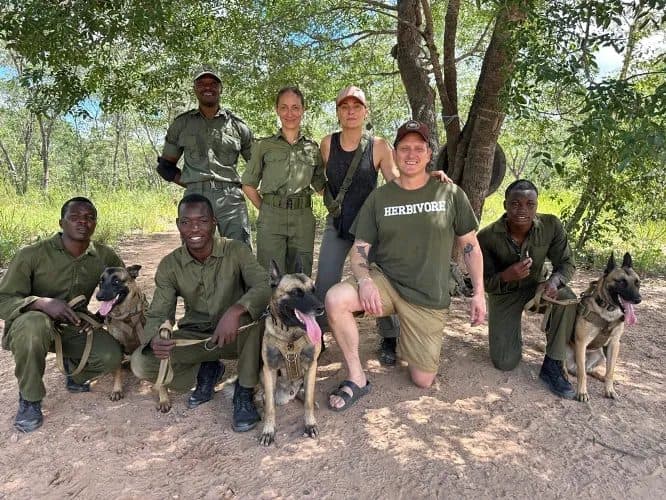
- One of Zimbabwe's largest and most rugged national parks, home to elephant, lion, leopard and species found almost nowhere else in the country.
- More than three decades of neglect left it exposed to poaching and degradation. It is now in structured recovery.
- The communities around Chizarira face extreme poverty, so conservation and social investment have to move together, not in sequence.
- Protecting Chizarira protects a far larger ecosystem, connected by migratory corridors across southern Africa.
An integrated five-pillar model
Pillar 1
Ecosystem protection
Strengthening park protection systems: ranger capacity, patrol vehicles, field equipment and conservation infrastructure.
Pillar 2
Community development
Investing in healthcare, education, water access and infrastructure for the communities who share this ecosystem.
Pillar 3
Women's empowerment
Expanding opportunities for women as leaders, entrepreneurs and agents of community stability.
Pillar 4
Wildlife-crime rangers
A dedicated unit that builds community-based information networks and disrupts organised wildlife crime.
Pillar 5
Local employment
Creating conservation-linked livelihoods that provide sustainable income for local residents.
Delivery and investment
Investment and growth trajectory
The programme scales in phases: building operational capacity inside Chizarira first, then expanding into the wider ecosystem.
2026
USD 2,421,440
Establishes operational capacity and the core systems the recovery runs on, including an initial six-month scale-up phase of USD 1,210,720.
2027
USD 3,370,515
Includes a USD 150,000 scoping initiative for the neighbouring Chirisa Safari Area, the first step toward one larger, contiguous ecosystem across the Zambezi Valley.
2028
USD 5,033,285
Includes a USD 750,000 launch of operations in Chirisa.
Chizarira in numbers
- 2,000 km²
- Critical wilderness within the Greater Zambezi Valley ecosystem, roughly 494,000 acres.
- 20 years
- Ecosystem mandate with the Zimbabwe Parks and Wildlife Management Authority.
- 347
- Patrols conducted in the past year, with 1,528 snares removed and 40 arrests.
- 21,220 km
- Patrol distance covered over 2,790 field nights.
- 500 g
- Cyanide recovered, preventing mass wildlife poisoning.
- 103
- New jobs created by 2028, alongside 110 existing staff.
- 12,000
- People living in the communities surrounding the park.
- 10+
- Community projects underway across the ecosystem.
Who we work with
Delivered in partnership with Defend and the Zimbabwe Parks and Wildlife Management Authority, under a 20-year ecosystem mandate.

Stand behind the people bringing this park back
Your gift funds the rangers, the K9 unit, the water points and the clinics that are bringing Chizarira back for the wildlife and the communities who share it.
Donate NowAbundant Village is a US-registered 501(c)(3) nonprofit. Tax ID 93-1914783. Donations are tax-deductible as allowed by law.